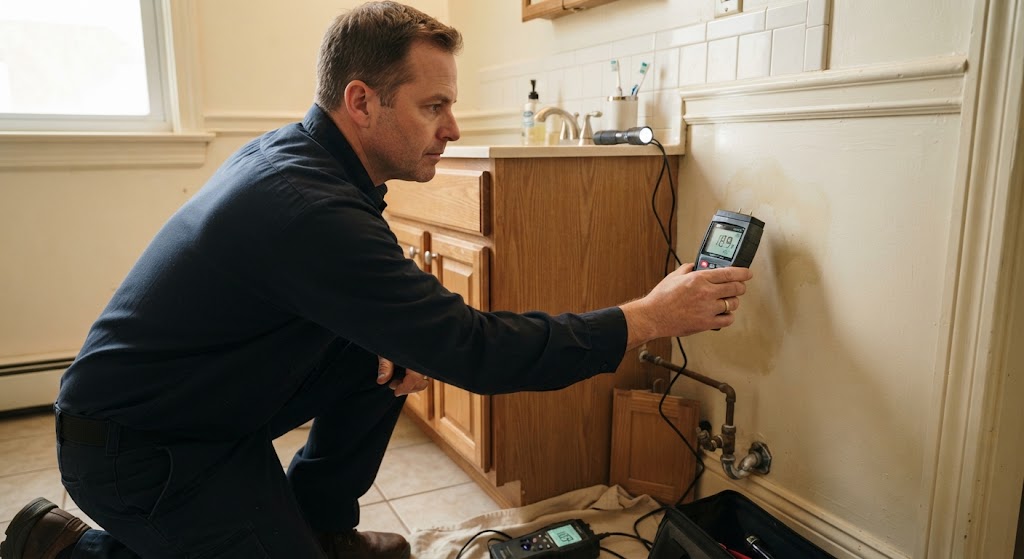
Plumbing Pipe Leak or Groundwater Infiltration? We Deliver Definitive Answers
Finding moisture, damp carpets, or standing water in your lower level is alarming, especially in finished basements outfitted with entertainment spaces, guest bedrooms, and home offices. Before spending thousands of dollars on extensive perimeter waterproofing French drains or ripping apart finished drywall, you need to know with certainty whether you are dealing with a water in basement plumbing leak Livingston issue or weather-related foundation seepage. Our non-invasive acoustic testing, thermal cameras, and chemical water testing provide rapid, indisputable clarity.
Livingston's terrain ranges from rocky elevations near Riker Hill Art Park to flatter glacial loam areas near Northfield Center and the Livingston Mall area. Heavy rainstorms frequently create hydrostatic groundwater pressure around foundation walls, while simultaneously, decades-old domestic copper supply lines embedded in basement framing are prone to pinhole fatigue.
Warning Signs of Basement Plumbing Leaks
Distinguishing a domestic pressurized pipe leak from outdoor soil runoff requires evaluating specific indicators:
- Moisture That Appears on Sunny, Dry Days: If water pools across your basement floor during extended stretches of dry, sunny weather without a drop of rain, the water source is almost certainly internal plumbing.
- Continuous Hissing Sound Behind Basement Drywall: The quiet sound of running or escaping water behind utility room framing or under ceiling sheetrock when all household taps are closed points to a basement pipe leak Livingston homeowners must resolve quickly.
- Unexplained Water Meter Movement: Your municipal water meter's low-flow indicator triangle turns steadily while all upstairs fixtures are silent.
- Dampness Around Water Heaters and Sump Pits: Puddles accumulating around hot water tanks, boiler loops, or floor drains that fail to dissipate.
- Musty Mildew Odor Restricted to Lower Living Areas: A heavy, stale odor permeating lower level trim and carpeting, indicating a wet basement leak Livingston NJ property owners cannot see directly.
Local Causes: Livingston Finished Basements & Aging Infrastructure
Many 1950s–1980s homes in Livingston have undergone basement conversions over recent decades. During these renovations, plumbing supply lines, heating distribution loops, and drain pipes were enclosed within insulated stud cavities, tongue-and-groove paneling, or drywall without inspection access. Over time, minor settling in North Jersey clay subsoils places mechanical strain on overhead supply manifolds, while mineral accumulation causes pinhole corrosion in copper fittings. Additionally, basement sump pump discharge lines can crack underground, recycling pumped water right back against foundation walls.
Our Non-Invasive Basement Diagnostic Method
We systematically eliminate guesswork using certified scientific diagnostics:
Water Chemistry Sanitizer Testing
We test standing basement puddle samples on-site for chlorine and fluoride. Municipal drinking water contains these sanitizers, whereas natural storm groundwater never contains chlorine or municipal fluoride additives.
Calibrated Supply Line Pressure Isolation
Using precision digital pressure gauges attached to basement boiler drains or utility taps, we isolate domestic hot and cold supply loops to confirm or rule out an active supply line breach.
Thermal Imaging Moisture Trajectory Mapping
Our infrared FLIR cameras trace moisture temperature footprints upward through vertical wall studs, identifying whether water originated from an overhead upper-floor bathroom or ground-level masonry.
Acoustic Listening & Moisture Penetration Probes
Ultrasonic listening probes detect water escaping under pressure within enclosed ceiling bulkheads and drywall soffits, marking the exact stud bay requiring plumbing access.
Finished Basement Moisture Protection
Do not allow contractors to knock down hundreds of square feet of finished drywall on a hunch. Our pinpointing isolates the exact pipe failure, ensuring that a New Jersey licensed master plumber only needs a small surgical opening to execute the repair, saving your finished basement recreation room.
What Happens After the Leak is Found: Solutions Compared
Once our diagnostics establish the true moisture source, property owners can take appropriate, targeted action:
| Moisture Cause | Identified Mechanism | Corrective Action | Contractor Type |
|---|---|---|---|
| Pressurized Supply Line Pinhole | Copper pipe pitting inside basement ceiling joists or framing | Targeted pipe section replacement or overhead PEX bypass | NJ Licensed Master Plumber |
| Drain or Waste Stack Crack | Failing PVC joint or corroded cast-iron vertical stack | Targeted sectional stack replacement with rubber couplings | NJ Licensed Master Plumber |
| Water Heater or Boiler Loop Failure | T&P valve weep, corroded dielectric union, or tank rupture | Component replacement or water heater changeout | NJ Licensed Master Plumber |
| Hydrostatic Groundwater Seepage | High water table or mortar settlement following heavy storms | Exterior gutter redirection, French drain, or sump pit installation | Basement Waterproofing Specialist |
Cost Factors for Basement Leak Detection
Diagnostic costs depend on whether the basement is unfinished with exposed joists or fully finished with drywall ceilings, the number of plumbing fixtures and heating loops routed through the lower level, and whether specialized chemical sanitizer testing is required to differentiate municipal water from groundwater. Pinpointing avoids thousands in unnecessary waterproofing installations.
Basement Moisture Prevention Tips for Homeowners
- Inspect your sump pump float switch and check valve every three months, especially before spring thaw rains.
- Install an automatic water shutoff sensor next to the basement water heater and washing machine hookups.
- Ensure downspouts and gutter extensions discharge roof runoff at least six feet away from foundation walls.
- Insulate cold water pipes in the basement to eliminate summertime condensation that mimics pipe leaks.
When Basement Moisture Becomes an Emergency
If water is rising toward electrical outlets, the base of the furnace, or electrical service panels, immediately shut off power to the flooded zone if safe, close your main water shutoff valve, and contact us for emergency leak repair diagnostic assistance. If you suspect an underground foundation slab failure, review our slab leak detection guide.
Basement leak calls are especially frequent throughout Livingston Center and Northfield Center where finished basements sit in dense residential neighborhoods. Learn more about local service coverage by visiting our Livingston Service Areas or exploring our primary leak detection in Livingston guide.
Frequently Asked Questions About Basement Leaks
We test the standing water for chemical municipal sanitizers (chlorine and fluoride) and perform static pressure decay testing on domestic supply lines. If the water contains municipal chlorine or the supply pressure drops while all fixtures are off, it is a pressurized plumbing leak, not storm groundwater.
Yes. Water follows gravity along vertical plumbing chases, electrical conduits, and timber framing, often travelling completely through first-floor ceiling cavities to pool on basement subfloors yards away from the actual pipe fissure.
Leaks near water heaters typically result from failing temperature and pressure relief (T&P) valves, corroded dielectric nipples, thermal expansion tank bladder ruptures, or internal tank lining failure caused by sediment accumulation.